I Photographed My Hairline Every Week for 90 Days. Here's the Diary I Almost Didn't Share.
A third-grade teacher's honest, week-by-week account of thinning hair, the scalp nurse who explained why nothing was working, and the small daily habit that finally changed her photos.
I'm 44. I teach third grade. Up until this year I had never once thought about my hairline — not once. This morning I stood under the bathroom light for probably four full minutes, tilting my head, trying to convince myself it was just the angle.
It wasn't the angle.
My part looked wider. My crown looked... quieter, somehow. Like there was simply less going on up there than there used to be.
Two weeks of side-eyeing the shower drain. I started counting — not obsessively, just enough to notice the number climbing. I bought the drugstore biotin gummies. I bought a "thickening" shampoo that smelled like a candle. Neither did anything I could point to.
So I did something that felt a little silly: I started taking a photo of my part line every Sunday morning, same light, same angle. Not to show anyone. Just so I'd stop being able to lie to myself about how fast it was moving.

One of the early Sunday check-ins — the start of a habit that ended up mattering more than I expected.
I mentioned it to Priya at pickup. She's the school nurse, and I knew vaguely that she'd gone back for some kind of scalp-health certification a couple years ago, but I'd never actually asked her about it.
I did not expect her whole face to change.
"Can I see the photos?" she asked. I pulled up four weeks of Sunday selfies in a school parking lot, feeling a little exposed. She scrolled through them twice, slowly.
"Dana," she said. "This is textbook. I need to explain something to you, and it's going to make you a little angry at every product you've bought so far."
Here's what Priya told me, in the parking lot, with the engine still running: hair follicles can get slowly strangled by a hormone called DHT — it builds up around the root, cuts off circulation, and starves the follicle until it just... stops. Not dead. Dormant.
"Shampoos sit on the hair you already have," she said. "Gummies get digested before a fraction of anything reaches your scalp. None of it goes near the actual problem, which is happening at the root, under the skin."
I asked the obvious question: if the follicle isn't dead, can it be woken back up?
"Usually, yes," she said. "If you get to it in time."
Priya sent me a link that evening to a roll-on serum she'd started recommending to patients at the clinic she consults for: Root & Scalp. Not a shampoo, not a pill — a small glass roll-on you run directly along the part line and thinning areas.
"The roll-on matters more than people think," she told me later. "A spray loses most of itself to the air and your collar. A roll-on puts the actives exactly on the scalp, and the rolling motion massages the area at the same time — you're stimulating blood flow every time you use it."
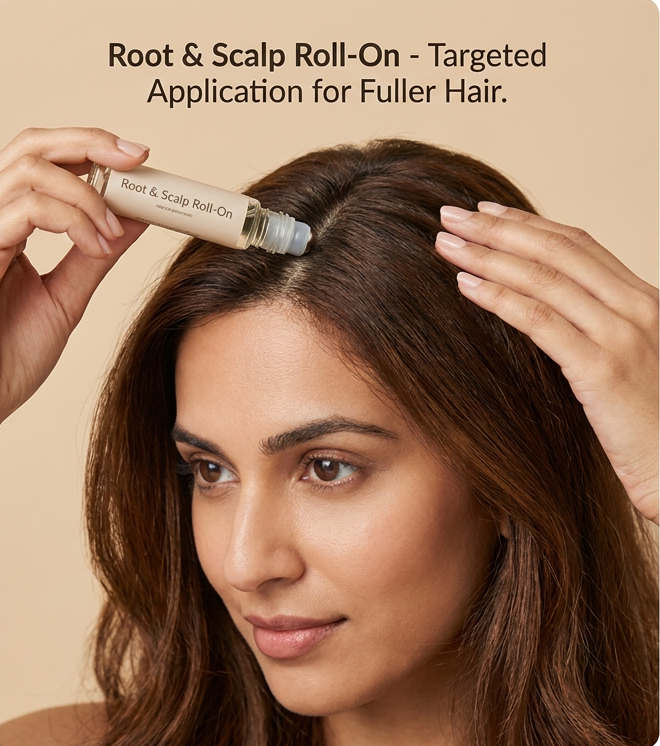
The roll-on Priya recommended — thirty seconds along the part line, morning and night.
I started that night. I didn't tell anyone except Priya. I didn't want to jinx it, and honestly, I didn't fully believe it would do anything different from the gummies.
I almost didn't post this photo. But here it is: for the first time since I started counting, the shower drain wasn't the highlight of my morning anxiety. And when I pulled my hair back for recess duty, one of the other teachers asked if I'd cut new layers in.
I hadn't touched a scissors. Those were baby hairs, along my temples, catching the light differently than the rest.
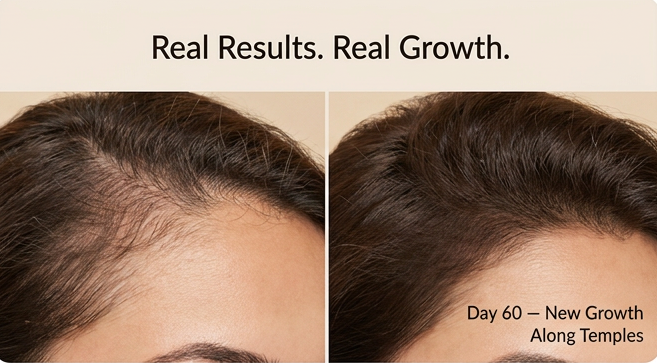
Day 60 — the check-in where I finally texted Priya a screenshot instead of just describing it.
I laid all thirteen Sunday photos out on my kitchen table this weekend, in order, the way Priya laid mine out that first day in the parking lot. My part line in the Day 90 photo does not look like the same head of hair as Day 1. My crown looks — for lack of a more scientific word — full again.
"This is why I keep telling patients to just try it for one real cycle," Priya said when I showed her the row of photos. "Everyone wants overnight. This isn't overnight. It's consistent, and then one day you look back at the photos and you can't unsee the difference."
I'm sharing this because six months ago I would have scrolled straight past a post like this one, rolling my eyes. If that's you right now — I understand. Take the photo anyway. It costs nothing and it's the only reason I believed my own results.
What's Actually in the Roll-On
Six actives, working on two different jobs — waking up dormant follicles, and protecting the hair that's already growing.
Redensyl®
Targets stem cells inside dormant follicles — density improved within 84 days in studies.
AnaGain®
From young pea sprouts — rebalances the growth-to-shedding ratio at the root.
Rosemary Extract
A natural DHT blocker shown in trials to perform comparably to 2% Minoxidil, without irritation.
Peptides
Reinforce keratin anchoring at the root so strands stay put before shedding starts.
Biotin (B7)
The structural building block of keratin — delivered right to the root instead of swallowed.
Caffeine
Boosts scalp microcirculation, feeding reactivated follicles the blood flow they need.
Based on published clinical data for key actives: Panahi et al., Skinmed (2015) · Pickart & Margolina, BioMed Research International (2018) · Ablon, Journal of Cosmetic Dermatology (2025).
Other Readers Who Started Their Own Diary
A few notes from people who tried Root & Scalp after reading Dana's story.
"I started my own photo diary after reading this. By week 9 my hairdresser asked what I'd changed. I hadn't changed anything except this."
"I'm postpartum and terrified of the shedding. Caught it early with the roll-on and my part line has genuinely stopped widening."
"Thirty seconds, twice a day, and no itching or weird smell like the other stuff I tried. My ponytail feels like it did a decade ago."
*Individual results may vary
30-day guarantee. Use it on your own hair. If you don't see visible new growth or less shedding, every penny comes back — and you keep the roll-on.
Before You Start Your Own Diary
Is Root & Scalp safe for all hair types?
Yes — the formula is applied topically to the scalp and is suitable for straight, curly, coily, colored, and chemically treated hair.
Why a roll-on instead of a spray or shampoo?
A roll-on delivers the full dose directly to the scalp instead of losing product to the air or your hair's surface, and the rolling motion massages the area to help circulation.
How soon will I notice a difference?
Most people report less shedding within 2 weeks, new baby hairs by weeks 3-4, and visible thickness by weeks 6-8. Full results typically build over 3+ months.
What if it doesn't work for me?
You're covered by a full 30-day guarantee. If you don't see visible results, you get a refund and keep the roll-on — no questions asked.
 Start My 90-Day Journal
Discounted intro pricing — while supplies last